
Amethyst
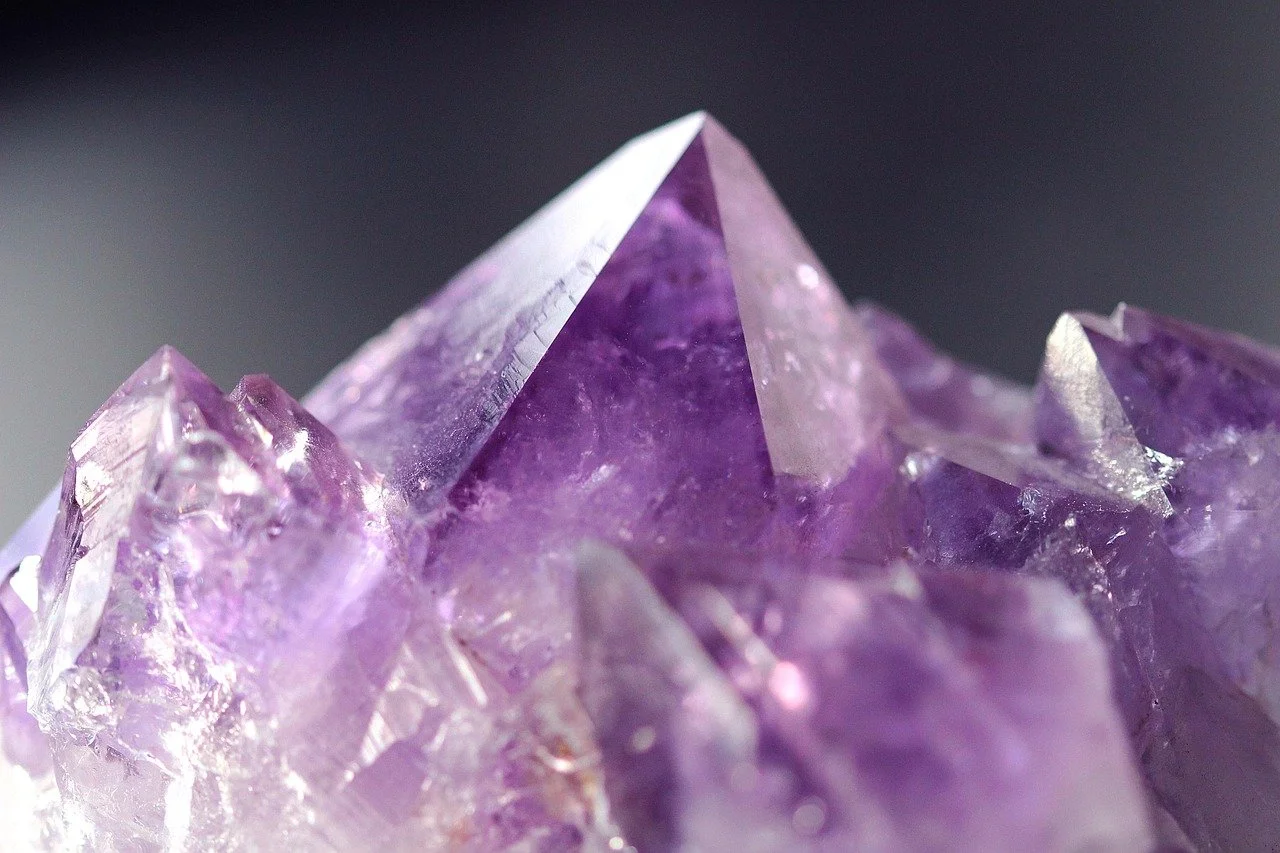
Amethyst has long been cherished for both its spiritual and historical significance. On this page, I explore Amethyst’s metaphysical and chakra uses, historical background, associated deities, and its natural formation in the earth providing you with a full picture of this calming, intuitive crystal.
Author: Luna Date: 9/15/25
-
- Chakra Associations:
Third Eye Chakra (Ajna) → intuition, spiritual vision
Crown Chakra (Sahasrara) → divine connection, higher wisdom
- Deity Associations:
Dionysus (Greek) – wine, transformation, legend of amethyst origin
Bacchus (Roman) – festivity, clarity of mind
Buddha (various traditions) – enlightenment, meditation
Diana (Roman/Greek Artemis) – moon, protection
- Angel Associations:
Archangel Zadkiel – forgiveness, transformation
Archangel Jeremiel – vision, clarity of life’s path
Archangel Michael – protection, strength
- Planetary Associations:
Jupiter – expansion, wisdom, spiritual growth
Neptune (secondary) – intuition, mysticism
- Birthstone:
Modern: February (primary birthstone)
Traditional: Associated with Pisces + Aquarius
- Crystal Pairings:
Rose Quartz → love + emotional balance
Citrine → prosperity (together known as Ametrine in natural form)
Clear Quartz → amplification of spiritual clarity
Black Tourmaline → protection and grounding
Selenite → high vibration, purification
- Metaphysical Uses:
Promotes calm, peace, and restful sleep
Strengthens intuition and psychic abilities
Aids in meditation and spiritual connection
Protects against negative energy and addictions
Encourages wisdom, clarity, and spiritual growth
Disclaimer
All content on this website, including descriptions of crystals and their historical or metaphysical associations, is provided strictly for informational purposes only. These materials are not intended to diagnose, treat, cure, or prevent any disease or medical condition.
I am not a medical professional, and no information presented here should be construed as medical advice or as a substitute for professional consultation, diagnosis, or treatment. Always seek the guidance of a licensed physician or other qualified healthcare provider with any questions regarding your health, medical condition, or treatment options.
Crystals, minerals, and stones are natural materials. Any traditional, cultural, or historical uses described are not scientifically substantiated and should be understood as folklore or symbolic associations only. Reliance on such information is entirely at the discretion and risk of the individual.
-
Amethyst is known for its gorgeous purple coloring; created by trace amounts of iron within the quartz, It is then exposed to heat and pressure along with radiation from naturally occurring elements such as Thorium, Uranium, or Potassium this is a slow process that occurs over thousands of years. The depth of the color is determined by how orderly the crystal lattice is and how evenly dispersed the iron atoms are within the matrix. This, however, is not enough to provide the rich hue: it also depends on the length of time and the amount of radiation the iron within the crystal has been exposed to. The deeper the Amethyst is found the more likely it is to have a darker coloring.
-
Amethyst is one of the most widespread varieties of Quartz it is found on nearly every continent. Some regions hold especially rich deposits, producing the finest and most sought-after specimens; Places such as Brazil, Russia, Uruguay, and Zambia dominate the commercial market for Amethyst due to the size and quality of the deposits.
-
Since Amethyst is so common and can be found around the world it has an extensive history among many ancient cultures. Some of the most notable in my opinion would be Egypt, Rome, Greece, India, China, and Ancient Europe.
Along the Nile River in Wadi El Hudi was an Amethyst mine which is believed to have opened around 2000 BCE during the reign of Pharaoh Mentuhotep IV. The Amethyst mined was high quality and became a symbol of royalty among the Egyptian ruling class. It was used in jewelry, amulets and talismans, for the culture Amethyst represented spirituality, good fortune, wisdom, and spiritual protection. It was often carved into forms representing their Gods and was placed into tombs to protect the pharaohs in the afterlife or to protect the tomb from grave robbers. Amethyst was believed to connect the wearer to the divine but it wasn’t until the mine had been exhausted in the mid 1800 BCE that amethyst started to fall out of fashion.
Ancient Rome sourced their Amethyst from several locations around the empire such as modern-day Italy and Germany; however, they also sourced amethyst from Egypt though not the same mine that was used by Egyptian pharaohs. Amethyst grew in popularity around first century BCE mainly due to Greek influence. It was believed that it would prevent intoxication and would assist in maintaining keen intellect. It was worn by Roman soldiers with the belief that it would protect them from harm. The stones were often carved into Intaglios which were small carvings to depict deities or mythological scenes. It was also made into jewelry and was prized by the upper class as a show of wealth. Ancient Romans also believed in the stone’s spiritual properties. Though Amethyst never really fell out of favor in Rome they eventually transitioned to other stones once they became aware of how abundant it was.
Amethyst received its name from the Greeks, and its original name is Amethystos, which means “not intoxicated.” Due to its wine color it was believed the stone could prevent drunkenness. They would carve drinking vessels out of the crystal, or they would wear them as protective jewelry. Not only did they believe it would prevent drunkenness they also believed it would assist in clarity of mind that would not only assist them in business, but also on the battlefield. Similar to other cultures of the time they believed that it could ward off evil. Eventually the popularity dwindled in Greece as larger mines were discovered in places such as Brazil and their ideology regarding its ability to help prevent intoxication has also declined.
In India Amethyst played a role in many aspects of their culture dating back to 1500 BC. It was sourced locally from regions like the state of Rajasthan and the area of Karur in Tamil Nadu and though all their mines contributed to some degree these were their primary sources. The stone was used in Ayurvedic gem therapy and Vedic astrology to promote wisdom, calmness, and mental clarity. It was used for assistance in meditation, heightened intuition, and spiritual connection. It was also used in the practice of Ratna Chikitsa for a balanced mind and emotional stability. For those who don’t know Ratna Chikitsa is gem therapy which is still practiced today. It was also associated with the crown chakra because of the belief it was connected to the divine. It is also used in connection to the third eye chakra believing it enhances spiritual intuition, spiritual insight, and psychic abilities. In Ayurvedic philosophies it is also believed it can assist with opening the third eye. In Vedic practices it was worn to protect people from Saturn’s transits It would be used as mala beads, worn as jewelry, placed on altars and other sacred spaces. It was also placed under pillows to ward off nightmares and promote peaceful sleep. Today it is still a popular crystal though it has slightly gone down in its popularity.
Recorded use of Amethyst in China dates to 770 -250 BCE and though it was traded via trade routes it was also mined domestically. In Chinese culture it is associated with the zodiac sign of the dragon and is seen as a protective stone. It was used to craft ornamental sculptures, vases, snuff bottles, and mythical figurines. In Chinese culture it was also used as medicine; it would be pulverized into a powder and administered to treat stomach ailments or used to treat emotional instability because of the stones calming effects, it was also believed to promote peaceful sleep. Travelers used it to protect against robbery and other dangers they may encounter however Amethyst was also a stone to symbolize wealth and power and has been found in ancient tombs. The stone never surpassed Jade in significance and it is still used today.
In ancient Europe evidence of Amethyst use dates back 25,000 years ago. It has been found in the graves of Anglo Saxons. The crystal has been found dating back to neolithic Europe as talismans for protection, beads and burial ornaments. In medieval Europe it was popular among the wealthy and was used to adorn the nobility of that era.
-
Modern uses of crystals are rooted in tradition and personal belief rather than scientific proof. there’s no scientific evidence behind their effects so many people treat them as supportive practices, not medical treatments.
Across the world Amethyst is still a popular gemstone and is still used in the same ways today as it was by our ancestors due to the hardness (MOHs) of Amethyst, it is often used in jewelry either as a focal point or as an accent. It is however still used to decorate the home and add a nice calm feeling of nature to this day.
Though Amethyst is not the only crystal believed to be connected to the divine it is still one of the most recognized and popular. It is associated with both the third eye and crown chakra and is used for aiding in:
Divine connection: Amethyst is frequently worn, held, or placed on the body while meditating to enhance or assist with connecting to the angelic realm.
Enhancing psychic intuition: Due to the connection of Amethyst to the third eye and crown chakra which are a part of the psychic centers it is used in aiding clairvoyance, channeling, along with enhancing the connection to all the other clairs.
Meditation: Amethyst has such calming energy that it is used for assisting in mental calm and clarity
Dreamwork: Due to its protective energies and its assistance in mental clarity Amethyst is used to assist in protecting against nightmares and remembering dreams and connecting to guides.
Aura: Used for strengthening and protecting the aura against negative energy and it is placed in rooms to purify the energy promote calm and harmony
Ritual work: Often placed on altars or in ritual spaces to cleanse the energy and invite in higher energies and harmonious vibrations.
This crystal is also used as symbol of sobriety because of the original belief that it can protect against intoxication.
Disclaimer
All content on this website, including descriptions of crystals and their historical or metaphysical associations, is provided strictly for informational purposes only. These materials are not intended to diagnose, treat, cure, or prevent any disease or medical condition.
I am not a medical professional, and no information presented here should be construed as medical advice or as a substitute for professional consultation, diagnosis, or treatment. Always seek the guidance of a licensed physician or other qualified healthcare provider with any questions regarding your health, medical condition, or treatment options.
Crystals, minerals, and stones are natural materials. Any traditional, cultural, or historical uses described are not scientifically substantiated and should be understood as folklore or symbolic associations only. Reliance on such information is entirely at the discretion and risk of the individual.
-
Amethyst is one of the most versatile Feng Shui stones. It brings spiritual clarity, protection, and peaceful energy into the home.
Northeast (Knowledge & Wisdom – Earth Element)
Placement: Front-left area of the home.
Purpose: Supports learning, meditation, and spiritual growth.
Energy Invited: Wisdom, focus, clarity of thought.
Forms Used: Clusters, geodes, points.
Pairings:
Amethyst + Clear Quartz → amplified spiritual clarity
Amethyst + Rose Quartz → balance of love and wisdom
Amethyst + Fluorite → focus and insight
Center of the Home (Harmony – Earth Element)
Placement: Middle of the Bagua map.
Purpose: Brings calm into family life and diffuses tension.
Energy Invited: Serenity, compassion, patience.
Forms Used: Large geodes, raw clusters, cathedral pieces.
Pairings:
Amethyst + Rose Quartz → peace and compassion
Amethyst + Selenite → purification and divine connection
Amethyst + Citrine → balance of joy and calm
Bedroom (Peace & Protection)
Placement: Bedside or under pillow.
Purpose: Prevents nightmares, eases insomnia, and protects from heavy energy.
Energy Invited: Deep rest, safe dreams, inner peace.
Forms Used: Tumbled stones, clusters, wands.
Pairings:
Amethyst + Lepidolite → peaceful sleep and calm thoughts
Amethyst + Black Tourmaline → protection and grounding
Amethyst + Rose Quartz → emotional and spiritual harmony
-
Caring for your crystals is important especially when it comes to using crystals as energy filters. Cleansing the crystal with smoke whether it is from incense or sage (depending on your practice) is a great way to clean your crystals regularly. Placing your crystals outside under the full moon can assist in the removal of negative energy as well as allowing the crystal to recharge. You can also wash and bless Amethyst with charged and blessed water to help cleanse the crystal in between full moons; Doing this with a soft bristle toothbrush and a little dish soap not only refreshes the energy but also removes the dust.
Disclaimer
All content on this website, including descriptions of crystals and their historical or metaphysical associations, is provided strictly for informational purposes only. These materials are not intended to diagnose, treat, cure, or prevent any disease or medical condition.
I am not a medical professional, and no information presented here should be construed as medical advice or as a substitute for professional consultation, diagnosis, or treatment. Always seek the guidance of a licensed physician or other qualified healthcare provider with any questions regarding your health, medical condition, or treatment options.
Crystals, minerals, and stones are natural materials. Any traditional, cultural, or historical uses described are not scientifically substantiated and should be understood as folklore or symbolic associations only. Reliance on such information is entirely at the discretion and risk of the individual.