
History and Expansion of the Chakras
This page offers a comprehensive exploration of the chakra system, tracing its origins in ancient texts through its evolution across spiritual, philosophical, and psychological traditions. Learn how chakra concepts emerged in Vedic scriptures, the Upanishads, and Tantric writings (with direct verse references), and how they have been interpreted and adapted across time, from early spiritual lineages to modern wellness practices, energy work, and integrative psychology. This historical and cross-disciplinary guide offers deep insight into the symbolism, cultural roots, and enduring relevance of the chakras in today's metaphysical and contemplative communities.
Date:10/20/2025 Author: Luna
-
The chakra system is often referred to within many spiritual communities and from my own experience most of these communities do not go into any actual depth that helps a person to understand and work with them. Often I would hear people refer to the chakras as something that was closed or blocked, and even more people would refer to them as wheels as part of a literal interpretation of the word.
I am in no way claiming to know all there is to know about chakras, far from it. What I am here to do is to demystify some of it based on my lived experience and what I have researched over the years.
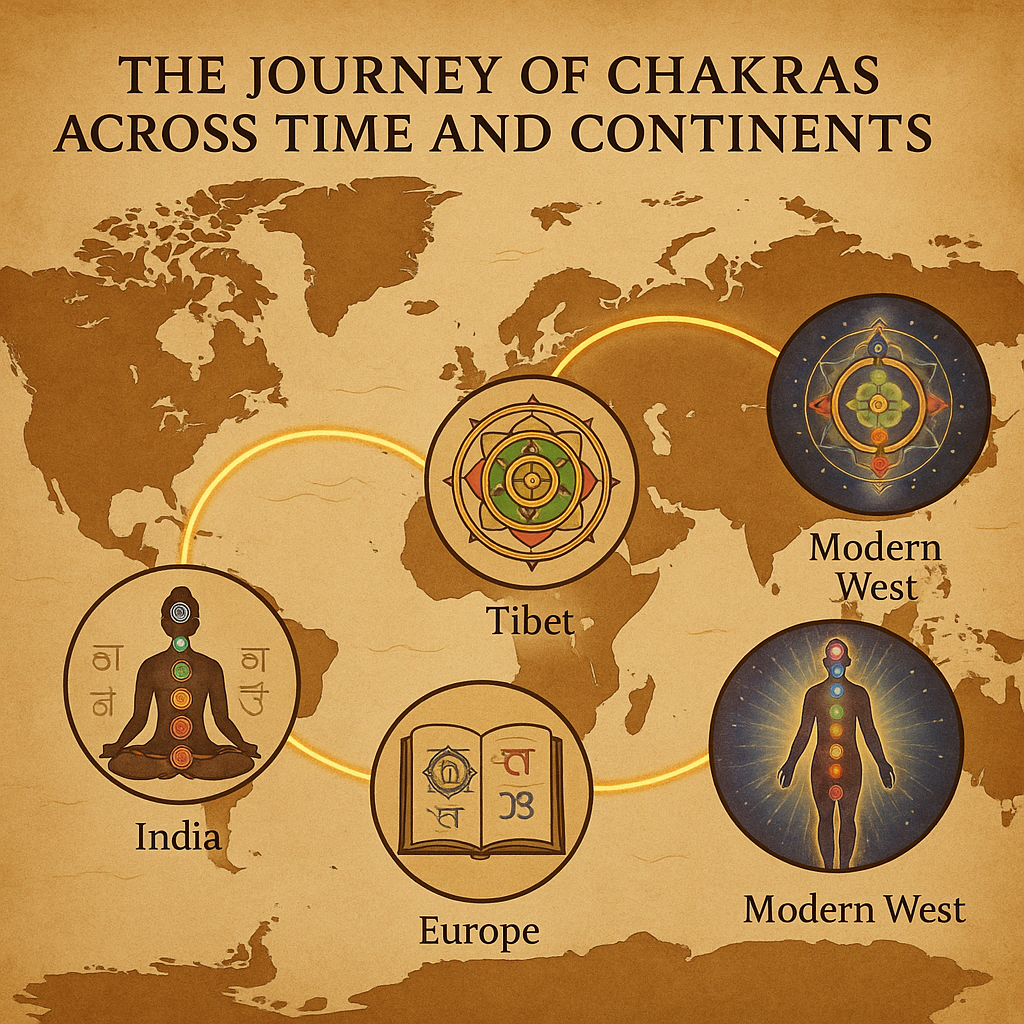
The earliest roots to the Chakras originates in the Hindu Vedic texts, especially references to prana (life force), nadi (energy channels), and bindu (point of consciousness). dating from 1500 - 500 BCE. In these texts the chakras were not described in the way we understand them today. The early texts focused on energy flow, breath, and consciousness moving through the subtle body. By the time of the Upanishads—particularly the Yoga-Kundalini, Brihadaranyaka, and Chandogya—the idea of chakras had begun to take shape, describing the body as a network of subtle channels and energy centers.
During the tantric period (500 – 1200 CE) the formal chakra system was developed and codified within the tantric traditions particularly Shaiva Tantra and Shakta Tantra. At the height of the tantric period several sacred texts recorded and refined the chakra system. Among them, the Kubjikāmata Tantra, Shat-Chakra-Nirupana, and Yoga-Kundalini Upanishad each played an essential role in shaping how energy centers were understood, mapped, and practiced. Together, they bridge early Vedic philosophy with later Tantric and yogic thought, forming the basis of the chakra model known today.
More about each of these texts can be found below.
Between 800 – 1400 CE the chakra system was integrated into Hatha yoga which itself was a product of Tantric philosophy. Hatha Yoga fully adopted the chakra system and put it into use. Yoga masters of this period refined the system into seven principal chakras, corresponding to psycho-spiritual states and stages of awakening and this version became the foundation of modern yoga and meditation systems around the world.
In early Buddhist teachings such as those in the Pali Canon, did not include chakras or subtle body maps. Their original focus had been mindfulness, liberation from suffering, and the eightfold path rather than the anatomy of energy fields. Early meditative traditions did however speak of Vayu (winds) and Nadi (channels) which later provided the groundwork for integrating chakra concepts. India was a very diverse nation with multiple different religions being practiced. This led to shared spaces of worship with free-flowing information between them. Through this exchange of ideas, the Buddhist practitioners came to learn of the energy systems from the Yogic masters. This led the Buddhist masters began adopting the Chakra system and then adapting it to their own philosophy. By the 10th century CE The Kalachakra Tantra formalized the Buddhist chakra system. It described 6 primary chakras and associated them with cosmic, physiological, and spiritual correspondences.
Within the Hindu practice the chakra system was believed to be a part of the subtle energetic or etheric body. It focuses on the energy of emotions within this field; the focus within Hinduism is to cultivate harmony between this etheric field and the physical body to reach higher states of consciousness. In contrast the Buddhist integrate the chakra system into the physical experiential body which can be seen in the Vajrayāna and Tantric traditions. They are seen less as metaphysical “energy wheels” and more as focal points for meditative awareness, physical centers that correspond to perception, emotion, and transformation through direct practice.
In the late 1800s, during the height of colonial interest in eastern philosophy, Western scholars and spiritualists began translating the Sanskrit texts. Helena Blavatsky who led The Theosophical Society helped introduce concepts like karma, prāṇa, and subtle bodies to Western audiences, blending them with Western esoteric thought. The first major translation of Tantric texts came in 1919 through Sir John Woodroffe’s The Serpent Power. Soon after theosophist CW. Leadbeater published The Chakras (1927), where he assigned the now-familiar seven chakra system distinct colors, organ associations, and psychic functions, ideas not found in the original Indian sources. By the mid-20th century these ideas merged with western psychology and the human potential movement, giving the chakras a new context as symbolic maps of consciousness and emotional health. Later, New Age authors like Anodea Judith (1970s–80s) solidified this version linking chakras to the endocrine system, rainbow colors, and personal growth.
What started in Hinduism and Buddhism and a spiritual map for meditation and Tantric practice focused on elevating the consciousness and attaining enlightenment became a universal language of self- awareness and energy in the west. Though the system was simplified in the West, it opened the doorway for millions to begin their own journey of self-transformation, allowing its wisdom to reach hearts and minds far beyond its original roots.
In my opinion and from my personal experience, the evolution of the Chakra system reflects how ancient spiritual wisdom adapts to meet humanity where it is. Transforming from a sacred map of enlightenment into a universal framework for healing, awareness, and inner balance. This system is a great way to understand the self and to assist you on the path of personal healing and growth. From there it can help you ascend to higher states of awareness and with time enlightenment.
-
Even though the new age spiritual movement presented and expanded on a broader 1 – 12 chakra system it is in no way a manufactured idea. For generations the chakra system stood at 7, however within the original teachings there was already room for expansion. Written in the Śiva Saṃhitā 2.1–5 claims there are 350,000 nadīs, suggesting an endless matrix of potential centers. In many early traditions, the more profound teachings were intentionally withheld from the uninitiated. With the explicit discussion of so many energy points the later expansion of the chakra system would be inevitable, which is what occurred in the modern era of spiritualism and energy practices.
In the 19th – 20th century theosophist such as Sir John Woodroffe, Helena Blavatsky, Charles Leadbeater, and Annie Besant merged Indian subtle anatomy with Western esotericism. Which detached chakras from purely yogic practice recasting them as universal energy portals. They saw chakras as etheric vortices of energy connecting the human body to astral and cosmic planes and were later expanded upon by other metaphysical writers. By the mid-20th century psychologists like Carl Jung and Anodea Judith along with Philosophers and Spiritualist Christopher Hills and Harish Johari laid the foundation for linking the chakras with human development and physiology. Chakras became psychophysical archetypes which was something that could be expanded conceptually to include soul, planetary, and cosmic levels.
As the New Age movement opened to channeling, crystal healing, and cosmic consciousness, practitioners began to perceive or receive information about chakras that extended beyond the physical body. The traditional seven centers were no longer seen as the full map of human potential, but as the inner framework of a much larger energetic architecture.
Channeled works and spiritual teachers such as Joshua David Stone, Aurelia Louise Jones, and Diana Cooper began describing an expanded chakra system which includes the Earth Star chakra, the Soul Star, Higher Self chakra, and the Stellar Gateway chakra. These additions symbolize the human energy field as a living continuum between Earth and Source rather than a closed system. It is thought that as you work with the chakra system the network begins to evolve with your expanded awareness.
Currently the two chakra frameworks that are accepted are the 1 – 7 or 1 -12. The number 12 follows the cycles of the modern era and monotheistic beliefs. If you consider that the number 12 corresponds to the 12 months of the year, 12 zodiac signs, 12 cranial nerves, 12 apostles, and the 12 tribes of Israel. The number 12 provides a sense of completion, but energy workers have found that working within the parameters of the 12 chakras is all that is needed to provide enough depth for spiritual evolution, and it remains manageable. Beyond 12 the energy points become abstract and less grounded in personal experience. The 12th chakra is seen as the gateway to the divine and in ascension systems it is considered the final gateway for higher consciousness. This is why out of the 350,000 energy nadis spoken of in the Śiva Saṃhitā the new age model stops at 12.
I intend to explore the 1 – 12 system along with discussing the minor chakras that connect them to create the energy circuits within us. These chakras are what provide the major chakras with the energy needed for them to function properly because the chakras are not just a map of our emotions, they are the channels in which energy flows through us allowing us to better connect to source consciousness.
-
There is a vast body of knowledge when it comes to theologies. I have put together a reference list for anyone interested in looking into what has been written in the historical texts to make it easier to track down the information. I doubt it is a full list, but I see it as a place to start.
Core Hindu Sources on the Chakra System
1. Kaṭha Upaniṣad
Tradition: Early Yogic / Upanishadic (600–300 BCE)
Relevant Sections: II.6.16–17
Notes: Describes the suṣumṇā nāḍī—the “narrow path” through which consciousness ascends to the Supreme. Though it doesn’t mention chakras directly, this imagery of an internal channel laid the metaphysical foundation for later chakra theory.
2. Chāndogya Upaniṣad
Tradition: Early Upanishadic (700–500 BCE)
Relevant Sections: VIII.6.6–8
Notes: Introduces the idea of nāḍīs (subtle channels) and the movement of prāṇa within the body. These early physiological references to inner pathways became the conceptual roots of the chakra system.
3. Yoga Kuṇḍalinī Upaniṣad
Tradition: Yogic / Tantric (1st millennium CE)
Relevant Sections: Chapters 1–3 (entire text)
Notes: One of the earliest texts to describe Kuṇḍalinī Śakti and her ascent through the spinal lotuses (padmas). It presents six major energy centers and a seventh at the crown, marking the first near-complete chakra model.
4. Ṣāṇḍilya Upaniṣad
Tradition: Yogic (1st millennium CE)
Relevant Sections: I.7–10 and I.17–21
Notes: Discusses prāṇāyāma, internal fire, and the awakening of energy through subtle centers. While the chakras are implied rather than named, the text reinforces the connection between breath, mind, and energy movement.
5. Dhyānabindu Upaniṣad
Tradition: Yogic / Meditative (1st millennium CE)
Relevant Sections: Verses 35–41
Notes: Mentions inner lotuses and the bindu (sacred drop) used in meditation. This imagery aligns with later chakra visualization techniques involving ascent through luminous centers.
6. Kubjikāmata Tantra
Tradition: Śākta / Kaula Tantra (10th century CE)
Relevant Sections: Chapters 17–18
Notes: Among the first Śākta Tantras to clearly outline six chakras along the spinal column, each housing deities and elements. It codified the Tantric subtle-body system that became the template for later works.
7. Śiva-Saṃhitā
Tradition: Haṭha Yoga (14th century CE)
Relevant Sections: Chapter V, Verses 96–101
Notes: Lists five principal centers (ādhāra, svādhiṣṭhāna, maṇipūra, anāhata, viśuddha). Emphasizes prāṇāyāma and meditation for awakening Kuṇḍalinī through these points.
8. Haṭha-Yoga-Pradīpikā
Tradition: Haṭha Yoga (15th century CE)
Relevant Sections: III.1–6 and III.107–111
Notes: Explains the suṣumṇā nāḍī, kuṇḍalinī, and bindu, forming the energetic framework for chakra activation, though it does not list all centers explicitly.
9. Ṣaṭ-Cakra-Nirūpaṇa
Tradition: Śākta Tantra (ca. 1520–1577 CE)
Relevant Sections: Verses 1–51 (full treatise)
Notes: The definitive Sanskrit exposition of the six primary chakras plus the sahasrāra. Details each center’s petals, deities, mantras, and elements. This text, translated by Sir John Woodroffe in The Serpent Power (1919), became the direct source for most modern chakra systems.
Core Buddhist Sources on the Chakra System
Hevajra Tantra
Tradition: Yoginī / Highest Yoga Tantra (8th–10th century CE)
Relevant Sections: Chapter II.4–5 (Yoginītantra-piṭaka)
Notes: One of the earliest Buddhist tantras to describe internal channels (nāḍī) and four primary cakras aligned along the central channel. These centers became the model for later Vajrayāna chakra systems.
2. Cakrasaṃvara Tantra (Śrī Heruka Abhidhāna)
Tradition: Yoginī Tantra / Vajrayāna (8th–10th century CE)
Relevant Sections: Chapters II and V
Notes: Describes the subtle-body structure of three channels (central, left, right) and four to six cakras located at the navel, heart, throat, and crown. This text is the foundation for the chakra model used in Tibetan six-yoga practices.
3. Guhyasamāja Tantra
Tradition: Mahāyoga / Vajrayāna (8th century CE)
Relevant Sections: Chapters 5–8
Notes: One of the earliest systematic expositions of Buddhist subtle anatomy — describing winds (prāṇa), channels (nāḍī), and drops (bindu). Chakras appear here as meditative loci for deity visualization and transformation of consciousness.
4. Kālacakra Tantra
Tradition: Anuttarayoga Tantra (10th–11th century CE)
Relevant Sections: Chapter II, verses 72–86 (Laghukālacakratantra)
Notes: Provides the most complete Buddhist presentation of six principal chakras, correlating them with elements, planets, and cosmological cycles. This system heavily influenced later Tibetan Vajrayāna physiology.
5. Vajraḍāka Tantra
Tradition: Yoginī Tantra (9th–10th century CE)
Relevant Sections: Chapter 3
Notes: Focuses on the body’s internal fire and four principal cakras where transformative energy gathers. Emphasizes yogic realization through internal heat (tummo), rather than therapeutic or symbolic interpretation.
6. Ārya-Tara Yogatantra and the Six Yogas of Nāropa Commentaries
Tradition: Tibetan Buddhist (Kagyu lineage, 11th century CE)
Relevant Sections: Tummo (inner heat) sections
Notes: Formalizes the six-chakra system used in Tibetan meditation, naming centers at the navel, heart, throat, crown, secret, and forehead. These chakras are visualized during advanced completion-stage yoga.
7. Tsongkhapa’s Great Exposition of Secret Mantra (sNgags Rim Chen Mo)
Tradition: Gelug / Vajrayāna (15th century CE)
Relevant Sections: Volume III, “Winds and Channels”
Notes: Synthesizes earlier Tantric material into a unified explanation of the subtle body and six principal cakras. Serves as a cornerstone for the Gelugpa understanding of completion-stage meditation.
Most Influential Modern Texts on the Chakra System
1. The Serpent Power — Sir John Woodroffe (pseud. Arthur Avalon, 1919)
Tradition / Context: Scholarly translation of Śākta Tantra (Indian source; British Indologist)
Relevant Sections: Part II, “Description of the Six Centers” (translation of the Ṣaṭ-Cakra-Nirūpaṇa and Pādukā-Pañcaka)
Notes: The first detailed English translation of Sanskrit texts on chakras and kuṇḍalinī. Though academic in tone, it introduced Western readers to the idea of six primary chakras plus the sahasrāra lotus. Woodroffe maintained close fidelity to traditional symbolism, making this the bridge between Indian esotericism and Western study.
2. The Chakras — C.W. Leadbeater (1927)
Tradition / Context: Theosophical / Western Esoteric
Relevant Sections: Chapters 1–5, “The Force Centers,” “Colours,” and “Functions of the Chakras”
Notes: A pivotal Theosophical reinterpretation. Leadbeater claimed clairvoyant observation of chakras, assigning each a specific color, organ, and psychic function. His work created the seven-chakra rainbow system that dominates Western metaphysics today — a framework, not present in original Indian sources.
3. Kundalini: The Evolutionary Energy in Man — Gopi Krishna (1967)
Tradition / Context: Yogic / Experiential Autobiography (India, Modern Yoga Renaissance)
Relevant Sections: Entire text; esp. Chapters 3–7 on personal kuṇḍalinī awakening
Notes: One of the first personal accounts of spontaneous kundalini awakening written for a global audience. Gopi Krishna linked ancient yogic experiences to modern psychology and biology, fueling interest in kundalini as both a spiritual and psycho-physiological phenomenon.
4. Bodymind: A Synthesis of Eastern and Western Approaches to Self-Healing — Ken Dychtwald (1977)
Tradition / Context: Human Potential Movement / Transpersonal Psychology
Relevant Sections: Chapter 5, “The Chakra System: A Map of Bodymind Integration”
Notes: Merged chakra symbolism with Western psychology and the endocrine system. Dychtwald reframed chakras as psychological energy centers corresponding to developmental stages, influencing modern somatic therapy and holistic wellness models.
5. Wheels of Life: A User’s Guide to the Chakra System — Anodea Judith (1987)
Tradition / Context: New Age / Integrative Psychology
Relevant Sections: Chapters 1–9, each devoted to one chakra from root to crown
Notes: The most widely read Western guide to the chakra system. Judith synthesized Tantric cosmology, Jungian psychology, and self-help frameworks into an accessible spiritual anatomy. Her rainbow-coded, seven-level model became the contemporary standard for energy healing, yoga instruction, and New Age spirituality.
6. Hands of Light — Barbara Ann Brennan (1988)
Tradition / Context: Energy Healing / Modern Metaphysics
Relevant Sections: Chapters 10–12, “The Human Energy Field” and “The Chakras”
Notes: Presented chakras as vortices of bioenergetic light within the aura, integrating clairvoyant perception, healing practice, and therapeutic psychology. Brennan’s model layered chakras into multiple auric fields and linked them to emotional and physical health, popularizing energy healing as a discipline.
7. Eastern Body, Western Mind — Anodea Judith (1996)
Tradition / Context: Transpersonal Psychology / Integrative Spirituality
Relevant Sections: Entire text (organized by chakra, from survival to transcendence)
Notes: Further developed the chakra–psychology bridge, presenting each chakra as a stage of human development and emotional patterning. This book formalized the chakra system as a therapeutic tool in Western counseling and personal growth.