
Root Chakra
Date: 11/22/25 Author: Luna Fae
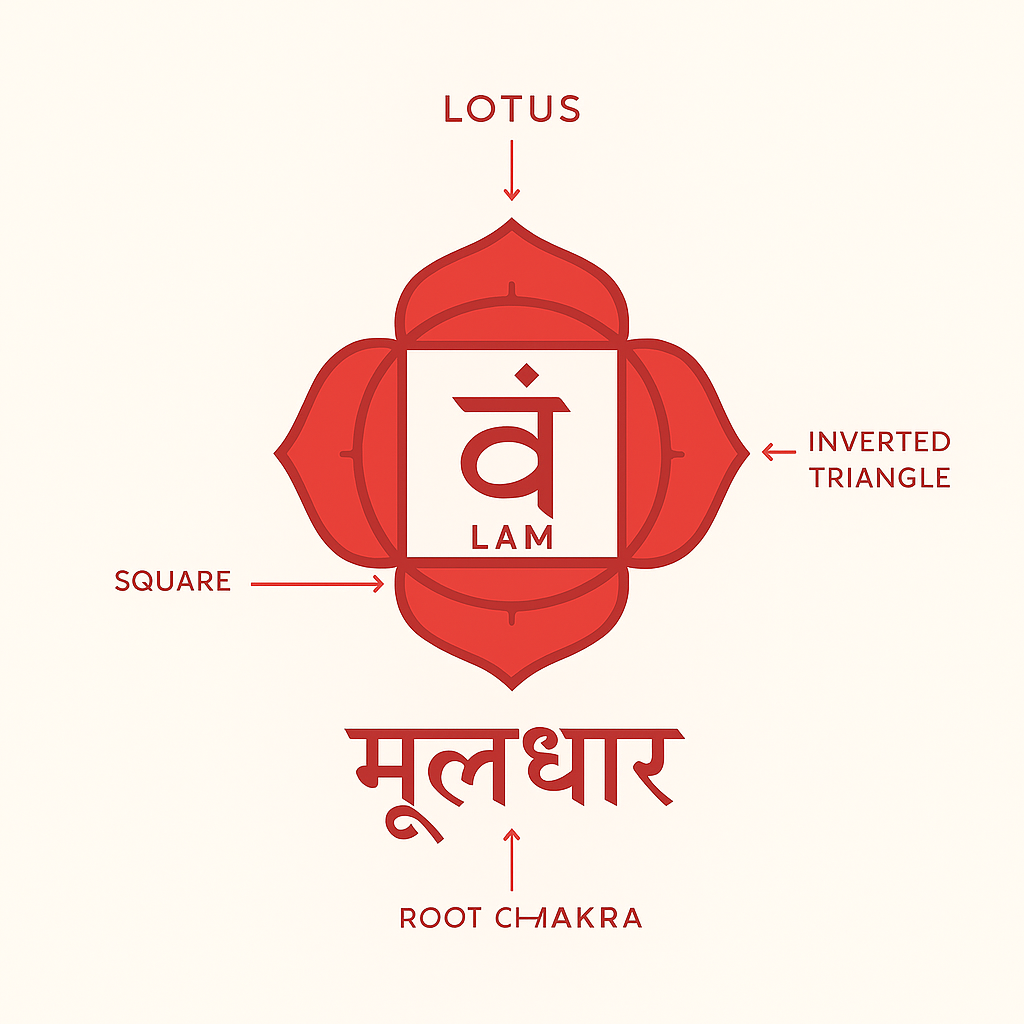
Summary: The root chakra deals with our sense of survival as well as our confidence. Here you will find not only an in-depth look at the location of the root chakra according to the original texts, but how to determine if your root chakra is balanced or imbalanced. A deep dive into how those two states appear in our lives along with ways we can bring them into alignment. Crystals that support the root chakra and links to the science supporting the effects of meditation on the symptoms of the root chakra imbalance.
-
Overview
The Root chakra is also known as Muladhara, it is the first of the original seven or the second in the expanded system. It is represented by a red lotus flower with four petals. The petals symbolize a balance between mind, intellect, consciousness, and ego. Within the flower you will find an inverted triangle representing the element of earth meaning the Muladhara represents the physical plan, gravity, grounding, and stability. This chakra helps anchor our consciousness to the material plane and the body. It is a physical reminder that a strong foundation supports our spiritual growth. The inverted triangle is also an ancient representation of the Yoni which means Source, womb, or vulva which symbolizes the energy of the divine feminine Shakti. This represents the creative and generative power at the base of the spine where the Kundalini energy sleeps. At the center is the symbol for Bija which means seed, The symbol also represents the mantra LAM.
Like all major chakras within the energy system there are minor chakras that support them. Their role is functionally important in supporting the strength and flow of energy. For the root chakra the energy flows
Earth star chakra 🡪 Foot Chakras 🡪 Knee chakras 🡪 root chakra.
The earth star chakra functions as an anchor point for the entire chakra system and when it is balanced it provides a stable energy source for the Root Chakra. This allows for emotional stability, vitality, and a sense of safety. When blocked, grounding becomes difficult, and the Root can oscillate between overactive (fear-driven) or underactive (dissociative).
The chakras in the feet are considered minor chakras; they regulate energy intake, discharge, and polarity (balance) between feminine and masculine currents. To put that scientifically they regulate positively and negatively charged electrons. This is why walking barefoot outside helps to discharge static electricity in the body thus preventing you from constantly shocking yourself from the buildup.
The knees also contain minor chakras, and they represent flexibility, humility, and your movement along your path through life. The chakras act as energetic stabilizers between the Earth Star chakra and the Root chakra. When these chakras are balanced, they help carry you through life grounded and confident, but when they are blocked it can show up as resistance to moving forward with your goals or struggling with stress.
*Check the minor chakra page for more info on the feet and knee chakras
The root chakra itself stretches from the perinium to the tip of the tail bone and is described in the original texts as such:
“ The Mulādhāra Chakra is situated at the base of the spine,
between the anus and the genital organ,
at the root of the sushumnā nāḍī,
resting upon the kanda (bulb),
and it has four petals.”- In the Śat-cakra-nirūpaṇa, verse 5
To explain this passage further, “Base of the spine” refers to the lowest point of the spinal column, the coccygeal region.
“Between the anus and genitals” specifically identifies the perineum as its front aspect or manifest point.
The kanda is the energetic bulb or root from which all nadis arise, just above the perineum, behind the pubic bone, and extending toward the tailbone.
-
Survival: When we experience events in our lives that could jeopardize our survival the energy is stored in our root chakra. Survival is what we feel we need to survive it could be something that threatens our way of life and for others it could be a life-threatening incident that occurred. When evaluating the survival aspect of the root chakra there is nothing too mundane to consider.
Trust: This is a big deal and doesn’t just cover being lied to. It incorporates our ability to rely on others when we need support; not just from our social group but also supporting ourselves. Trust in others is truly a whole different discussion that’s far more involved. For now, let’s focus on what we can control, which is ourselves. Can you trust yourself? When you make deals with yourself and then procrastinate you are letting yourself down. This can happen for a plethora of reasons, but one of those reasons is fear of change and low self-esteem. Both also tie into the root chakra as well. If you are looking to heal your root chakra this is one of the places that should be examined closely.
Belonging: When we feel a sense of belonging, we also have feelings of trust, and we are not in our survival instincts. The lack of this feeling is a warning light for other root chakra issues, belonging within ourselves is a great place to start if possible. I am not talking about feeling comfortable in our physicality, though this is important as well, but who we are as people. The feeling of not belonging can be due to prior experiences, as well as being aware of others’ experiences. This can cloud our clarity of the current situation and cause us to project past experiences into the moment. You can work on rebuilding your sense of belonging by connecting with those that allow you to feel comfortable in your own skin and in your own mind. If you truly can’t be yourself, you are in the wrong room. If people can’t accept you for you then they do not deserve you. You can own the room and still be humble.
Embodiment: This is about being comfortable in your own skin. This one is something that every single person experiences and I do have a thing or two to say about it. We don’t see what other people see when we look in the mirror. We see all our flaws, and we often can’t see around them. We judge ourselves in comparison to others and they do the same. Every one of us does this and we are not giving ourselves enough grace. If you are seeing something about yourself that can be changed without surgery, then make a point to change that. I had to restructure my entire personality to undo all the things I adapted for survival. It’s a lot of work and it takes a lot of time, but it is possible. If there is something you want to change don’t wait until tomorrow because tomorrow never comes. Make a plan and start now. When you try to procrastinate, put your foot down don’t do that to yourself because you deserve more, you are worth it. By doing this you are not only feeling better within yourself, but you are also working on self-trust and your sense of emotional belonging.
These four foundations of the root chakra have many branches.
Fear of the unknown, scarcity, not being enough, or not being good enough, sometimes fear of success even. Insecurity from things like financial, physical, or emotional instability, and this doesn’t have to be a current insecurity. These insecurities can be a blip on your timeline and still cause issues now. Feelings like anxiety, disconnection, hopelessness, fatigue, distrust, and shame.
Another thing that can cause a lot of this disruption can be traced back to neglect. Neglect can be a range of things from emotional, medical, needs etc. Neglect is an insidious form of abuse because it causes us to start to destroy ourselves from the inside. Its effects destroy our self-worth and our self-esteem. It deeply affects how we perceive ourselves and can be long lasting. One way I have found to combat this is by analyzing my own thoughts. Whenever I start to come down on myself, and it is linked to my self-worth I always stop my thoughts and think of the reasons I am worthy of what I am receiving.
-
Trigger warning: The root chakra deals with the symptoms of trauma and what follows is an in depth look at ways it can show up in our daily lives.
If you are easily triggered please skip this and go to supporting the root chakra section
If you have read what I have written about the history of the chakras, you will see that as the understanding of these energy points have evolved over time psychologists like Carl Jung and philosophers like Christopher Hills started exploring the chakras as a psychological map. I personally use it as a road map for understanding my own current patterns that may be linked to past experiences.
When the root chakra is balanced you will move through life with quiet confidence. You may not realize this, but others will. Your nutritional needs are balanced and provide you with stable energy, helping you to avoid excessive peaks and valleys throughout the day. You often feel secure in your surroundings, and you don’t question your ability to meet your own needs. You may have stressful moments, but you are able to mitigate those moments and return to center when the event has passed. When the root chakra is balanced you are able to stay present in the moment and not only make goals for the future but also work towards them. There is a peaceful calm that comes with a balanced root chakra that allows us to not only manage our own lives, but occasionally extend ourselves to help others.
When the root chakra is imbalanced, we are often focused on survival. These can be brief moments lasting for a couple of days to a couple of months often as a result of serious but transient situations. Once the situation is resolved our focus can easily transition back towards our goals. However, some of us are dealing with one thing after another or compounding past events that deepen our inherent survival instincts. The stress that comes from this can manifest as fear, agitation, irritability, and anxiety. When this goes on long enough it leads to a dysregulation of the nervous system and causes us to neglect ourselves from stress. Personal neglect can lead to improper nutrition by either consuming too little or too much as well as creating an inability to manage the day-to-day finances or even the household chores; this is such an overwhelming experience that further exacerbates the stress. In an attempt to get a break from it all you may find yourself doom-scrolling more or using other methods to escape the overwhelm. If our stress is based on scarcity or perceived scarcity it can cause us to buy things we don’t necessarily need or save things we would normally throw away. This can lead to hoarding which adds to the overwhelm, in situations like these it can be difficult to ask for help from others and lead to us feeling isolated or even unworthy of help. This can be for several reasons and one of those is from having our needs neglected by those we have trusted in the past, we often self-isolate or feel alone even when surrounded by those who love us. Another way this overwhelm can show up in our lives is with a desire to control our surroundings in an attempt to avoid more stress. This desire to control things has the opposite effect and only adds to the stress we are already under.
An imbalanced root chakra is a spectrum and everyone’s ability to manage their symptoms and heal them are as unique as you are. When we are in the extreme aspects of the spectrum, help from friends, family, or professional sources may be needed to help you get started in calming down the nervous system and transitioning the mind set from survival to healing. The best part about this is that as we work through the things that put us into this mind set to begin with can be resolved. Some things may take longer than others and some things may be more difficult, it is still possible. Below you will find some things that may help support your nervous system, but none of these should replace professional help if that is what you feel you need.
-
These are great ways to help support your Root Chakra as either a daily practice, a healing practice, or as a supporting method in conjunction with professional measures.
Breathing practice:
The breathing rhythm you want to follow is a breath in- slightly longer hold- then a slower exhale than the hold. The suggested pattern is 4 – 7 – 8, but if this is uncomfortable you can do shorter durations such as 3 – 6 – 7 or longer. The point is the exhale is the longest. Another important point is these are deep belly breaths. You are taking the breath deeply into the lungs and this kind of breathing should expand the abdomen. To further your ability to regulate the breath is to breathe through the nose and out through the mouth.
If you are doing this to calm anxiety, panic attack, or intense stress. This pattern is something you should work up to as the breathing starts to calm you then you can extend the inhale which will extend the exhale. The hold can be skipped in the beginning as it isn’t as important as the longer exhale. The pattern shouldn’t be shorter than a 2 second in and a 5 second exhale to prevent hyperventilation.
Steps:
- If possible, get into a comfortable position
- Fully exhaling through the mouth making the whoosh sound
- Now inhale through the nose for a count of 4
- Next hold gently for a count of 7. Don’t clench the body while performing the hold
- Last slowly exhale for a count of 8
- Repeat at least 4 times
The reason this works is because the measured breathing stimulates the vagus nerve and switches you from the sympathetic nervous system (fight or flight) to the parasympathetic nervous system (rest and digest). Please see research under bibliography
Can help with calming anxiety, panic, and intense emotions: This slow breathing also calms the body down because when you are breathing in slow measured breaths, you’re telling your body you are not in danger because rapid breathing is fear-based response and tells your brain and nervous system you are in danger. Slower breathing tells your body you are safe.
Massage:
Since the feet and knee chakras help energy flow from the earth star chakra to the root chakra these two massages will be helpful to support the root chakra. This is a brief guide on those massages, however you can find an in depth and detailed guide and explanation here.
How: Use circular motions (clockwise on the right, counterclockwise on the left) starting at the heel which is the densest, most grounding point.
Work up through the arches (Spleen/Liver meridians) and outer edge (Bladder/Gallbladder meridians).
Finish at the ankles, visualizing energy drawing upward from the Earth.
Use grounding oils such as vetiver, cedarwood, or patchouli to deepen connection.
Root release:
● Place your palms on the lower abdomen and tailbone (you can rest your hands there during meditation or gently massage the sacrum).
● Slow, circular movements help release tension in the psoas and pelvic floor; both associated with survival stress and trauma storage.
Stretches:
For any stretches and yoga poses, if you are unfamiliar with the proper way to perform these there are many guides and videos that can be found on a viewing platform of your choice. It is important not to overdo it or to do it incorrectly as that can cause injuries.
Anything that supports the PSOAS will benefit the root chakra
Seated Forward Fold (Paschimottanasana): Elongates spine and releases hamstrings, soothing the root.
Knee-to-Chest Stretch (Apanasana): Lying down, pull knees toward the chest; this releases lower back tension and stimulates digestion.
Pigeon Pose (Eka Pada Rajakapotasana): Opens deep hip muscles and the psoas, helping release emotional tension stored in the pelvis.
Butterfly Stretch (Baddha Konasana): Feet together, knees open wide; gentle pulsations mimic grounding breath rhythms.
Yoga poses:
● Mountain Pose which builds postural awareness and connection to the Earth.
● Garland Pose opens hips, grounds energy, and strengthens the pelvic floor.
● Warrior I helps anchor stability through the legs; cultivates courage and strength.
● Bridge Pose opens hip flexors and strengthens glutes and lower back.
● Child’s Pose restores calm, gently compresses the root area.
Mantras and affirmations:
Mantras are chanted with your personal resonant frequency. To find the tuning you want to chant the words and once you hit the proper tuning you will feel the vibration in the corresponding part of the body.
The Mantra is Lam pronounced Lahm the vibration should be felt in the pelvis and up the spine. The tone should be at a pitch of ~ 396hz
Affirmations are spoken and you can come up with your own, but if you need a starting point here are a few you can start with:
“I am safe in my space.”
“I trust the earth to support me.”
“My body and spirit are grounded in the present moment.”
When I use affirmations, I will often list all the ways I am safe or supported and I will ground myself in the moment by focusing on my surroundings and my breath. It is very similar to the earth star chakra meditation I do, but in this case, I don’t focus on my feet. I have a crystal I use, and I focus on all the tactile aspects such as weight, temperature, texture, etc. Things like this really help anchor the affirmations for me.
-
This is a short list of crystals that work with the root chakra. A good rule is if the crystal matches the chakra color it will work with that chakra. Due to this being the root chakra black and brown crystals will also work as they represent the soil roots grow into. Crystals of other colors may also be aligned to work with the root chakra as well so don’t be afraid to have some fun with it.
Crystal: Red Jasper
Properties: Nurturing, steady energy; restores physical vitality.
Placement: Place on lower spine or carry during grounding meditation.
Crystal: Hematite
Properties: Magnetic, stabilizing; helps discharge excess energy.
Placement: Hold in left hand during breathing practices.
Crystal: Smokey Quartz
Properties: Transmutes negative energy; anchors subtle body.
Placement: Wear as pendant or place near feet during meditation.
Crystal: Black Tourmaline
Properties: Protective and detoxifying; aligns biofield.
Placement: Keep near doorway or base of spine during rituals.
Crystal: Garnet
Properties: Stimulates circulation and passion; revitalizes root energy.
Placement: Wear near pelvis or as bracelet to maintain vitality
-
This is the science that supports the claims regarding meditation: Below you will find links to open source research.
· Vierra, J. A., Murray, J., & McGrady, A. (2022). Effects of sleep deprivation and 4-7-8 breathing control on heart rate variability and cognitive performance in healthy adults. (Open-access via PMC)
[Full text: https://www.ncbi.nlm.nih.gov/pmc/articles/PMC9277512/· Magnon, V., Dutheil, F., & Vallet, G.T. (2021). Benefits from one session of deep and slow breathing on vagal tone and anxiety in young and older adults.Scientific Reports, 11: 19267.
[Full text: https://www.nature.com/articles/s41598-021-98736-9] Nature· Kirk, U. & Axelsen, J.L. (2020). Heart rate variability is enhanced during mindfulness practice: A randomized controlled trial involving a 10-day online-based mindfulness intervention.PLOS ONE, 15(12): e0243488.
[Full text: https://doi.org/10.1371/journal.pone.0243488 PLOS Journals· Natarajan, A. (2023). Heart rate variability during mindful breathing meditation.Frontiers in Physiology, 13: 1017350.
[Full text: https://www.frontiersin.org/articles/10.3389/fphys.2022.1017350/fullPMC+1· Russo, M.A., Santarelli, D.M., & O’Rourke, D. (2017). The physiological effects of slow breathing in the healthy human.Frontiers in Human Neuroscience, 11: A (open access).
[Full text: https://www.ncbi.nlm.nih.gov/pmc/articles/PMC5709795/
Below is a link to a searchable database on heart math institute so you can see what the have researched on the topic
· Research Library: “Basic Research / Peer-Reviewed Studies” — lists items with “Download the complete paper, click here.” HeartMath Institute+1
This is a downloadable e-book I have found that is free to down load. I am in now way affiliated with heart math institute so please use at your own discretion.
· The “Science of the Heart” overview e-book—this appears to be free for download (though it’s more of an overview than a peer-reviewed journal article). Click here HeartMath Institute+1