
Rose Quartz
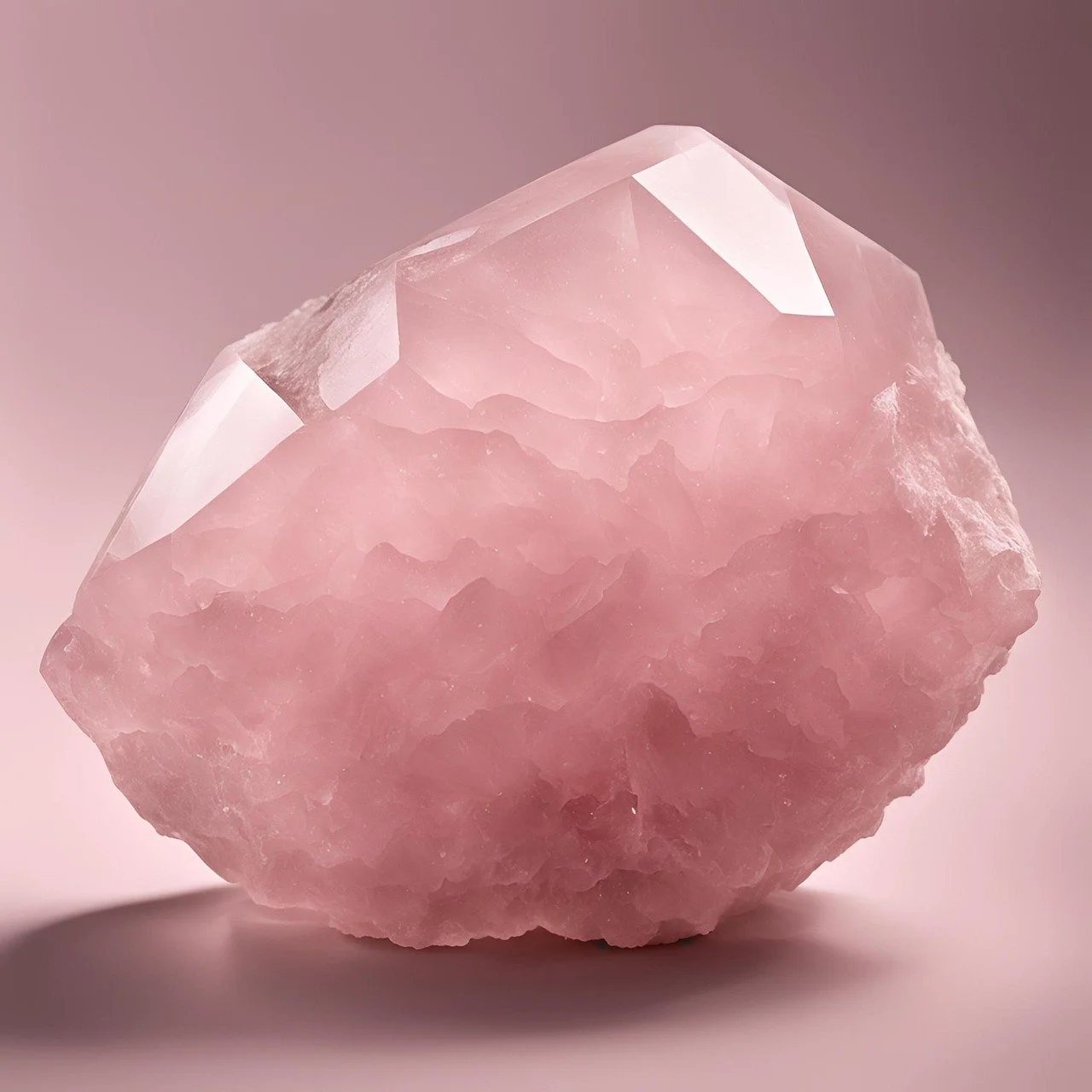
Known as the stone of love and emotional healing, Rose Quartz holds deep meaning across both ancient and modern traditions. This page explores its heart-centered energy, chakra connections, metaphysical uses, historical context, and how it's naturally formed in the earth.
Author: Luna Date: 10/05/25
-
- Chakra Associations:
Heart Chakra (Anahata) → love, compassion, forgiveness, emotional healing
- Deity Associations:
Aphrodite (Greek) – goddess of love and beauty
Venus (Roman) – love, harmony, attraction
Isis (Egyptian) – magic, healing, divine motherhood
Tara (Buddhist/Hindu traditions) – compassion, mercy, healing
Freya (Norse) – love, fertility, passion
- Angel Associations:
Archangel Chamuel – unconditional love, relationships, forgiveness
Archangel Ariel – heart-centered healing, nature, feminine energy
Archangel Haniel – harmony, emotional balance, intuition
Planetary Associations
Venus – love, beauty, attraction, relationships
(Secondary: Moon – nurturing, emotional cycles, inner harmony)
- Birthstone:
Modern: None officially
Traditional/Alternative: January (in some traditions, alongside garnet); also linked symbolically to Taurus & Libra (ruled by Venus)
- Crystal Pairings:
Amethyst → calm, spiritual clarity
Clear Quartz → amplifies loving energy
Garnet → passion + tenderness
Moonstone → intuition + compassion
Citrine → joy + optimism
- Metaphysical Uses:
Promotes unconditional love (self-love and romantic)
Heals emotional wounds and trauma
Encourages compassion, forgiveness, and empathy
Attracts new relationships and deepens existing ones
Supports restful sleep and calming dreams
Enhances heart-centered meditation and energy work
-
Rose Quartz is a variety of Quartz that forms from silica rich fluid that also contains traces of fibrous minerals such as Dumortierite. This is what scatters the light creating that pink hue. These inclusions are typically too tiny to be seen with the unaided eye, but it is what gives Rose Quartz that milky color typical to most of this particular crystal. A rare occurrence of Titanium, Iron, or Manganese which can create a transparent pale pink. This is not common, and the pink is rather pale.
Most Rose Quartz forms in massive interlocking crystals rather than forming points. Its formation is attributed to slow consistent cooling of the pegmatite or vein allows silica to crystallize in a dense network, producing the solid chunks you see cut and polished for jewelry or carvings.
-
Significant Deposits of Rose Quartz occur in several places; Brazil has large consistent deposits. Occasionally it will produce the rare transparent high-quality Rose Quartz, but it typically produces large pieces with consistent color that are usually translucent to partially transparent. This mine is the primary source of large carvings, spheres, and jewelry grade rough material.
Madagascar has extensive pegmatite fields which produces rich pink coloring that usually takes a high polish. It is preferred for decorative carvings and high-end lapidary. Occasionally when cut and polished properly it will have a slight shimmer or asterisms (star effect) when cut into a cabochon.
Rose quartz is South Dakota’s official state mineral, and this is because it is mined in the black hills. The quality is not as high as Brazil, but it is known for its charming pink color with nice translucency. Usually larger than those found in Brazil, but less translucent. These pieces are also used for decorative carving or jewelry.
India has a long history of mining Rose Quartz. It is widely used for beads and carvings due to its light to medium pink color and translucent structure. There are smaller yet notable deposits in Namibia and Mozambique which have a vibrant pink color. These pieces are typically translucent and favored for cabochons or polished décor.
Smaller deposits also occur in Russia, Sri Lanka, and parts of Europe. It is generally similar in quality, massive and translucent, suitable for carvings, tumbled stones, and metaphysical use.
-
Rose quartz beads and amulets dating back to roughly 3000–2000 BCE have been uncovered in ancient Mesopotamia, modern-day Iraq, Syria, Turkey, Iran, and Kuwait. While the Sumerian, Akkadian, Babylonian, and Assyrian cultures left no written record of how these pink stones were used, this likely reflects the fact that minerals were known by different names at the time. Also, the attributes were the same given to other pink stones. They didn’t single out specific minerals, but rather they were done by color. Archaeologists have since identified these artifacts as what we now call Rose Quartz. In temple Rose Quartz, beads and amulets have been found which were drilled and attached to cords or sewn into clothes. The stones were found in temple inventories, and it is thought that they attribute Rose Quartz to attract love and favor because many pink stones symbolize affection and harmony. Many Mesopotamian charms were meant to ward off illness or malevolent spirits. Priests would use the stones in incantations and binding ceremonies. The Akkadian stone list groups stones together by color and then corresponds them to organs as well as deities. Pink stones were associated with goddess Ishtar/Inanna, the goddess of love, fertility, war, and desire. Stones were placed on altars or worn during love charms or fertility rites to invite the goddess’ blessing. The stones have also been found in graves and royal tombs. It is believed they were placed there to protect the deceased in the afterlife and to carry the favor of the gods in the next world.
Though there is no known written record of Ancient Egypt’s use of Rose Quartz there are artifacts that have been discovered that date to approximately 2600 – 1600 BCE. This has been in the form of beads, and cosmetic jars made of pink toned Quartz. Rose Quartz objects have also been found among burial stones that were known to be used as protection. Due to the archaeological evidence that has been uncovered it is believed that Egyptians placed a spiritual significance on the crystal. The culture linked pink stones to love and fertility so Rose Quartz would have been associated with Goddess Hathor who symbolized love, beauty, and motherhood. Egyptian healers and priestesses sometimes used polished stones in ritual cleansing and to soothe the skin. Rose quartz, with its soft color and smooth texture, fits well with these beauty and healing practices, reinforcing its link to divine femininity.
In ancient Greece, Rose Quartz was tied to Aphrodite, and legend says its soft pink hue came from the moment her blood mingled with Adonis’s. The myth tied Rose Quartz to love, desire and beauty causing it to be used in charms for romance, charms, and fidelity. The Greeks would exchange charms made of the crystal and sometimes place them by the marital bed to invite harmony and passion. Theophrastus (4th century BCE) described pink varieties of quartz in early mineral treatises. Finely ground Quartz and smooth polished pieces were used in cosmetic and skin-care rituals. Women would gently rub cool stones across the face or mix powdered Quartz into ointments, believing it helped preserve youth and a clear complexion. Rose Quartz has also been found among burial objects likely as a symbol of eternal love and possibly as a token for protection.
In Rome the crystal was linked to Goddess Venus symbolizing love, Beauty, and fertility. This made the stone favored for love charms much like the Greeks. Charms in the form of rings, carved pendants, and beads were worn to draw affection, ensure fidelity, and draw favor from Goddess Venus. They would also carve gems with doves or myrtle plants which were known to be sacred to Venus which was a way of combining art and subtle magic. Rose Quartz has also been found by archeologists at burial sites and household shrines in the form of beads and small carvings. It is believed that not only where they used as symbols of love but also symbols of protection. Polished pieces of Rose Quartz were used in cosmetic routines, believed to preserve youth and a healthy complexion when applied cool to the skin.
Rose Quartz uses in India dates to 2500 – 1900 BCE during the Indus Valley civilization. Archaeologists have excavated beads and cabochons made of pink Quartz. These stones appear in jewelry and ritual ornaments, showing the stone was valued thousands of years before the Vedic period. In later Vedic and post-Vedic tradition, pink stones were linked to the heart chakra and to deities of love and compassion such as Kamadeva, the god of desire. Believing to encourage harmony, emotional healing, and devotion they carved small idols, mala beads, and pendants from the stone. Polished pieces were occasionally placed on altars or in sacred water vessels, where the gentle hue symbolized purity and universal love. Ancient gem-healing texts describe pink Quartz among stones recommended to balance the heart’s energies and promote emotional well-being. Ayurvedic practitioners used smooth pieces of pink Quartz in massage or facial treatments to reduce heat and soothe the skin.
Pink Quartz has also been discovered in Ancient China dating to 3000 – 2000 BCE. Quartz beads and small ornaments have been found in archaeology sites alongside Jade, agate, and other valued stones. They were usually drilled and polished into beads, pendants, and small carvings. In Chinese tradition pink and red stones were symbols of joy, vitality, and the hearts energy and later with the fire element. This made Rose Quartz a natural association to affection, harmony, and emotional balance. Polished beads were found in the form of pendants at burial sites as tokens of protection, love and good fortune. In healing pink Quartz was sometimes used as a “heart-soothing” stone, believed to calm the spirit and support relationships, an idea that persisted into later dynasties.
Most of the above information is not back up by a written record and instead is supported by what archaeologists have found and writing regarding stones and their uses based on color. Some of what has been inferred is based off lapidary texts.
-
Much like the civilizations that came before us Rose Quartz plays a role in modern day spirituality and witchcraft. It is considered one of the most popular stones on the market and a go to crystal for matters of the heart. It is often placed or worn over the heart to balance heart energy, and to bring peace. When used during meditation or setting intention it is either held or placed over the heart chakra to heal resentment, invite self-love, or assist with empathy. Often placed in bedrooms or near the marital bed to invite love and strengthen marital bonds. It is often used to help facilitate self-love through affirmations and carrying it in a pocket or wearing it as a bracelet or pendant. Carrying a polished stone or a palm stone is believed to assist in anxiety relief and promote calm. Rose Quartz may even be used when healing from grief or emotional upheaval. Modern skin care routines for those in the crystal community utilize facial rollers or Gua Sha tools to soothe skin and encourage a healthy glow. Rose quartz is also placed in bathrooms, in bath water, and by candles to promote an atmosphere of calm relaxation.
Disclaimer
All content on this website, including descriptions of crystals and their historical or metaphysical associations, is provided strictly for informational purposes only. These materials are not intended to diagnose, treat, cure, or prevent any disease or medical condition.
I am not a medical professional, and no information presented here should be construed as medical advice or as a substitute for professional consultation, diagnosis, or treatment. Always seek the guidance of a licensed physician or other qualified healthcare provider with any questions regarding your health, medical condition, or treatment options.
Crystals, minerals, and stones are natural materials. Any traditional, cultural, or historical uses described are not scientifically substantiated and should be understood as folklore or symbolic associations only. Reliance on such information is entirely at the discretion and risk of the individual.
-
I often look at Feng Shui as a way of weaving crystals into the natural energy grid of a home. Rose Quartz, with its soft pink vibration, carries the essence of love, compassion, and healing. Below are the most common placements and how I use them.
Southwest (Love & Marriage – Earth Element)
Placement:
Far-right back corner of the home or bedroom (using the Bagua map). Place pairs of stones here.
Purpose:
Strengthens partnerships, invites romance, and nurtures trust.
Energy Invited:
Love, intimacy, commitment, and balance between two people.
Forms Used:
Hearts, spheres, pairs of towers or raw pieces.
Pairings:
Rose Quartz + Amethyst → love with wisdom
Rose Quartz + Garnet → tenderness balanced with passion
Rose Quartz + Moonstone → compassion and emotional understanding
Center of the Home (Health & Harmony – Earth Element)
Placement:
The energetic heart of the house, often a central room or open space.
Purpose:
Spreads harmony throughout the household and eases tension.
Energy Invited:
Unity, compassion, emotional healing for all family members.
Forms Used:
Large clusters, spheres, or free forms as a central anchor.
Pairings:
Rose Quartz + Clear Quartz → amplifies love energy across the home
Rose Quartz + Amethyst → dissolves conflict, supports calm communication
Rose Quartz + Green Aventurine → compassion and growth in relationships
Bedroom (Personal Energy & Intimacy – Earth/Water Blend)
Placement:
On both bedside tables (always in pairs) or small stones under pillows.
Purpose:
Encourages rest, emotional closeness, and romantic harmony.
Energy Invited: Tenderness, trust, peaceful dreams, and intimacy.
Forms Used:
Polished hearts, tumbled stones, small towers, paired figurines.
Pairings:
Rose Quartz + Moonstone → fertility, cycles, emotional renewal
Rose Quartz + Garnet → love with passion and vitality
Rose Quartz + Lepidolite → deep sleep and emotional calm
Personal Spaces (Self-Love & Healing – Heart Element)
Placement:
On a vanity, meditation altar, or worn as jewelry.
Purpose:
Anchors daily practices in compassion and builds self-acceptance.
Energy Invited: Confidence, inner peace, and emotional release.
Forms Used:
Palm stones, pendants, altar grids, tumbled stones.
Pairings:
Rose Quartz + Clear Quartz → amplifies self-love intentions
Rose Quartz + Black Tourmaline → grounding with emotional safety
Rose Quartz + Green Aventurine → resilience and optimism
Work Desk (Relationships & Career Harmony – Earth/Metal Blend)
Placement:
Southwest corner of the desk for partnerships, or near phone/computer for softened communication.
Purpose:
Encourages diplomacy, eases workplace tension, and brings warmth to professional relationships.
Energy Invited: Cooperation, kindness, creativity, and financial luck.
Forms Used:
Small, polished stones, pyramids, or paired mini spheres (subtle forms that won’t clutter the desk).
Pairings:
Rose Quartz + Citrine → prosperity and joyful expression
Rose Quartz + Fluorite → clarity balanced with empathy
Rose Quartz + Black Tourmaline → protection from negativity while maintaining compassion
In Feng Shui, I always remind people: rose quartz works best in pairs when the focus is relationships, and in clusters or large forms when the purpose is radiating harmony across an entire space.
Disclaimer
All content on this website, including descriptions of crystals and their historical or metaphysical associations, is provided strictly for informational purposes only. These materials are not intended to diagnose, treat, cure, or prevent any disease or medical condition.
I am not a medical professional, and no information presented here should be construed as medical advice or as a substitute for professional consultation, diagnosis, or treatment. Always seek the guidance of a licensed physician or other qualified healthcare provider with any questions regarding your health, medical condition, or treatment options.
Crystals, minerals, and stones are natural materials. Any traditional, cultural, or historical uses described are not scientifically substantiated and should be understood as folklore or symbolic associations only. Reliance on such information is entirely at the discretion and risk of the individual.